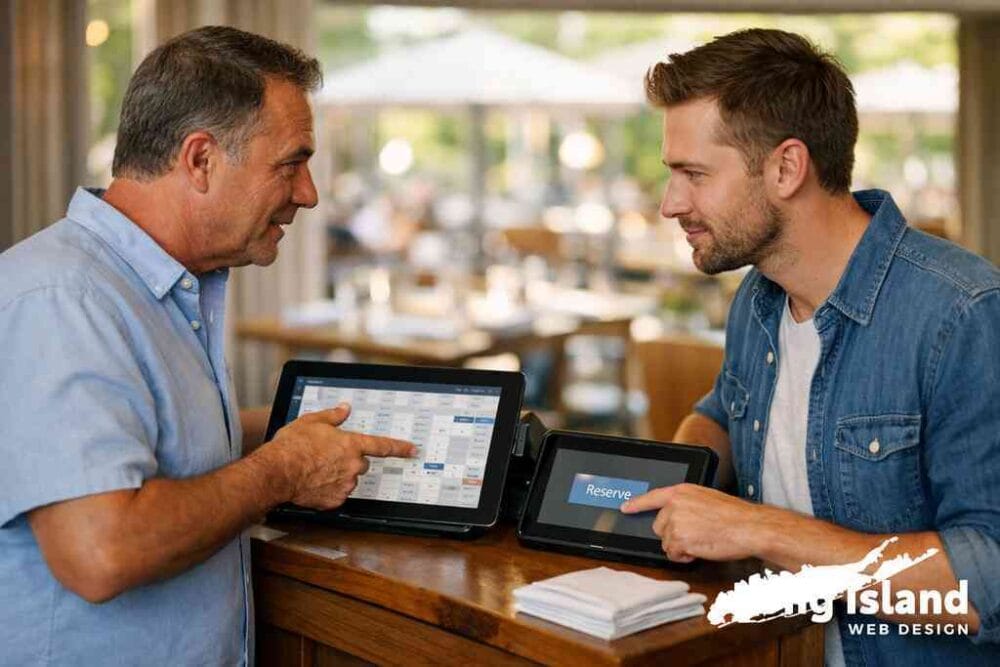
Why a summer rush can still leave restaurant tables empty
You can have a full patio, a steady dinner crowd, and still watch the reservation calendar stay strangely light. That mismatch frustrates owners because the room feels busy while the future remains uncertain. If you are checking a slow booking dashboard, take a breath. The problem is often not demand. It is the gap between interest and action.
The hidden leak between a busy patio and an empty reservation calendar
Many restaurants lose bookings in the tiny moments after a guest gets interested. They see your sign, hear about you from a friend, or spot your restaurant website design for Long Island presence online. Then they land on a page that hides the reservation button, buries the menu, or loads too slowly. That is not a branding issue. It is a booking leak.
We hear this from restaurant owners almost every week. A family in Huntington may be ready to reserve, but they do not want to hunt. A couple in Commack may be comparing two places on their phones, standing outside in the heat. If the path feels awkward, they leave. The table did not disappear. The experience did.
Why mobile guests decide in seconds while standing on the sidewalk
Summer diners behave differently. They are often walking, driving, or changing plans quickly. Many are on mobile, and they make decisions in seconds. That is why a mobile-friendly restaurant website matters so much. It keeps the site readable, tappable, and fast on a small screen.
Here is the part most owners miss. A mobile visitor does not compare your website to your printed menu. They compare it to the next restaurant result. If your page pinches, zooms, or opens with a giant image that blocks the call button, they move on. That is especially true in Suffolk County and Nassau County, where diners have plenty of nearby choices.
How a slow or clunky site quietly pushes hungry diners to the next place in Commack or Huntington
A slow website feels like a long line at the host stand. People tolerate it once. They rarely tolerate it twice. In our experience, the biggest mistake is treating website friction as a minor inconvenience. It is not minor when someone is hungry. It is a lost table.
A restaurant on the North Shore may have beautiful food and a loyal crowd, yet still lose first-time visitors online. One owner told us their summer specials were drawing attention on social media, but reservations stayed flat. The site took too long to load on phones, and the menu PDF opened awkwardly. Once the mobile path improved, people found the reservation link faster and stayed longer. Small fix. Real impact.
What a restaurant website has to do before Google will even notice
Google is not impressed by a pretty homepage alone. It looks for structure, speed, clarity, and signals that match search intent. That is why responsive web design for restaurants in Suffolk County matters before anything else. If Google cannot understand or trust the page, your menu and booking link may never get the visibility they deserve.
Why responsive web design and mobile-friendly pages matter more when tourists and locals search on phones
Responsive web design means your site adapts to any screen size without breaking the layout. On a restaurant site, that means the menu stays readable, the reservation button stays visible, and tap targets stay easy to use. It also supports mobile-first indexing, which means Google primarily evaluates the mobile version of your site. That is not a theory. It is how search works now.
A mobile-friendly site also supports better UX design for restaurant websites. When a visitor can scan hours, parking, specials, and the booking path in one glance, they trust the business faster. That matters for tourists, but it also matters for locals searching between errands. The best restaurant website design for summer reservation growth on Long Island removes hesitation before it starts.
How Long Island SEO helps your restaurant show up for local search terms in Suffolk County and Nassau County
Good design gets the visit. Long Island SEO helps the visit happen in the first place. If you want search engine visibility for phrases like dinner near Huntington, brunch in Smithtown, or waterfront dining in Babylon, you need local relevance. That starts with keyword research for local businesses, on-page SEO, and content that reflects actual neighborhoods.
The phrase search engine optimization Long Island is broad, but restaurant search is very specific. A deli in Islip needs different wording than a steakhouse in Garden City. That is why a local strategy matters. Long Island SEO for restaurant search visibility helps Google connect your pages with nearby diners who are ready to act. It also supports broader digital footprint growth across map listings, pages, and local mentions.
What Google Business Profile optimization and local listing management do for dinner and lunch traffic
Search results do not stop at your website. For many diners, the Google map pack is the real decision point. Google My Business is now called Google Business Profile, and it plays a major role in local discovery. Proper Google Business Profile optimization for restaurants helps your hours, phone number, menu links, and photos show up cleanly.
Local listing management matters too. If your hours differ across Yelp, Apple Maps, and Google, customers get confused. Confusion costs lunch traffic fast. It also hurts trust before dinner. Accurate listings, current photos, and consistent contact details reduce friction and improve local search visibility across Nassau County and Suffolk County.
Why page speed, technical SEO, and schema markup can affect whether your menu or reservation link gets seen
Page speed optimization affects both users and rankings. A slow page can frustrate diners before they even see the menu. Technical SEO makes sure the site loads cleanly, crawl paths work, and core content is easy for search engines to read. Add schema markup for restaurants, and you help Google identify your hours, cuisine, location, and reservation information more clearly.
A quick example: a restaurant in Brookhaven wanted more lunch traffic, but their menu link sat below a heavy image slider. We saw the issue immediately in a basic Google Lighthouse review. Once the page structure improved, the important links appeared faster and the browsing experience felt calmer. That is the kind of change that turns a curious search into a booking.
The booking path that turns a casual browser into a table request
A restaurant website should guide people like a good host guides guests: clearly, quickly, and confidently. If the booking path feels confusing, people stop. That is why conversion rate optimization is not just an ecommerce idea. It belongs on restaurant sites too.
Where the reservation button should live so diners do not have to hunt for it
Your reservation button should be visible immediately, on every key page. It should not hide inside a menu, a footer, or a contact page only. The best reservation button optimization keeps the action simple. The guest should never wonder what to do next.
Think of it this way. People on mobile scan more than they read. So the button must stand out without looking pushy. In a strong restaurant booking flow, the reservation link appears near the top, repeats naturally, and follows the user as they scroll. That is one of the simplest improvements with the biggest payoff.
How menu page optimization can make brunch, happy hour, and seasonal specials easier to book around
Menus do more than list food. They create timing cues. A strong menu page can show brunch hours, happy hour windows, and seasonal dishes in a way that encourages action. That is menu page optimization in practice. It helps guests plan around your availability instead of guessing.
We have seen this work especially well for small business website design on Long Island. If your oyster special is buried inside a PDF, it disappears. If it sits on a clean page with prices, descriptions, and a direct booking path, it can support reservations. The same is true for online ordering integration and special event menus. Clear structure reduces hesitation.
Why online reservation system links, contact form optimization, and call buttons need to work together
A restaurant guest may prefer different actions. Some want to book online. Some want to call. Some want to ask a quick question. Your site should support all three without making anyone repeat themselves. That is why restaurant booking flow and reservation button optimization should be part of the design plan.
Strong contact form optimization keeps forms short and simple. Call buttons should work on mobile with one tap. Reservation system links should open cleanly and match the page’s tone. When those tools work together, your booking funnel becomes smoother and more predictable. That is the difference between a visitor and a table request.
How conversion rate optimization helps more visitors complete a booking instead of bouncing
Conversion rate optimization looks at where people leave and why. Maybe the homepage is too busy. Maybe the form is too long. Maybe the booking calendar is hard to read. A small change can keep a guest moving. That matters more than most owners realize.
Here is a simple comparison.
Website elementCommon problemBetter resultReservation buttonHidden in footerVisible on every pageMenu pageHeavy PDF fileFast, scannable pageContact formToo many fieldsShort, clear formMobile layoutHard to tapEasy to use with one handThis is where UX design and custom website design earn their keep. A cleaner path reduces bounce rate and helps more browsers become diners.
Why summer restaurant marketing works best when the website and campaigns talk to each other
Marketing fails when traffic lands on a weak page. That is the whole story. A strong site, paired with smart promotion, gives each click a place to go. This is where a digital marketing agency Long Island should think beyond impressions and focus on bookings.
How social media marketing for restaurants can drive traffic to a page that is ready to convert
Social media marketing for restaurants works best when the post and the landing page match. If you promote a lobster roll special, the page should show that special clearly. If you post a backyard patio photo, the page should support the reservation action. That alignment lowers confusion. 
The same idea applies to branding agency work and restaurant branding. Consistent photos, colors, and messaging help people recognize you faster. Then your site feels familiar when they land. We have seen that kind of consistency help restaurants in Huntington and Babylon keep more of the traffic they already earned.
What Google Ads for restaurants and PPC management can do when paired with a strong landing page
Google Ads and PPC management can drive immediate traffic. But ads alone do not save weak web pages. If the landing page is cluttered, the campaign pays for clicks that never turn into calls or reservations. That is why Google Ads management for restaurants on Long Island should always connect to a focused page.
A strong landing page for restaurants uses one message and one action. It may highlight summer reservations, group dining, or a special menu. It should not try to say everything at once. Pair that with precise targeting, and your ad spend works harder. That is especially useful for restaurants competing across Nassau County and Suffolk County.
How content marketing for hospitality supports local search visibility during peak dining season
Content marketing for hospitality gives Google more reasons to trust your site. Blog posts, event pages, and neighborhood pages can support local search visibility long after one campaign ends. They also help answer common questions, which keeps your digital footprint active. That matters during peak season, when diners search fast and compare fast.
One small restaurant in Smithtown wanted more summer weekday traffic. They had great food but almost no supporting content. We suggested practical pages about happy hour, private events, and seasonal specials. The point was not to write for the sake of writing. The point was to give search engines and customers more useful entry points.
Why review management and online reputation management matter when visitors are choosing between similar spots
People read reviews before they book. Even when they do not say it out loud, they do it. Review management and online reputation management help you respond, learn, and stay credible. They also support local SEO for restaurants because fresh, relevant reviews build trust.
If two restaurants look similar, the one with clearer reviews often wins. That is human behavior. It is also a search signal. A strong reputation, paired with a clean website, reduces doubt at the exact moment doubt is most expensive.
The next move that protects bookings after the season gets busy
Busy seasons expose weak systems. That is uncomfortable, but useful. If bookings are inconsistent now, the right fix is usually not another patch. It is a cleaner structure, better maintenance, and a plan that fits how diners actually search.
What to fix first if your current site is holding back reservations
Start with the obvious friction points. Check your mobile layout, booking link, load speed, and menu visibility. Then review your Google Business Profile and local listings. If those basics are off, nothing else matters much.
Use this checklist:
- Make the reservation button visible on every major page.
- Replace heavy PDFs with readable menu pages.
- Confirm hours, address, and phone numbers everywhere.
- Test the site on multiple phones.
- Review page speed and search snippets.
That is practical work, not guesswork. If you want help, a website redesign for restaurants that need more reservations can solve the deeper issues without starting from zero.
When a website redesign for restaurants makes more sense than another quick patch
Sometimes a patch becomes a pile of patches. That is when a redesign makes sense. If the site is hard to update, slow, or built around old assumptions, a fresh structure may be more efficient than endless fixes. WordPress development for restaurants is often a strong fit here because it can support easier updates and better content flow.
A redesign is especially helpful when your current site cannot support modern mobile-first indexing, accessibility, or new booking tools. It also gives you room for better restaurant website design, stronger messaging, and more natural conversion paths. The goal is not a prettier page alone. The goal is a site that helps people book.
How website maintenance, website security, SSL certificates, and ADA compliant website updates keep your digital front door open
A restaurant site is a live business tool. It needs care. Website maintenance keeps plugins updated, links working, and pages intact. Website security and SSL certificates protect the trust diners need when they submit forms or click reservation links. These basics matter more than most owners think.
Accessibility matters too. ADA compliant website work helps more people use your site, and it reduces legal and usability risk. Clear text, good contrast, and keyboard-friendly navigation help everyone. A site that is easier to use is often easier to book.
Why a local team in Commack can build a plan for Long Island restaurants that need steadier bookings in Suffolk County and Nassau County
Local knowledge matters because Long Island is not one market. A restaurant in Commack faces different search behavior than a place in Garden City or on the South Shore. A team that understands web design in Suffolk County, web design in Nassau County, and nearby areas like Huntington, Smithtown, Babylon, Islip, and Brookhaven can shape the message more accurately. That is where Commack restaurant web design for local growth becomes practical, not abstract.
At Long Island Web Design, the work starts with what your customers actually do. They search on phones. They compare quickly. They book only when the site makes sense. If your restaurant needs steadier summer reservations, start by reviewing the pages that matter most today, then request one focused audit from a local team that understands both design and search.
Frequently Asked Questions
How much does a restaurant website cost on Long Island?
I cannot give a single price without seeing the scope, because costs vary by pages, features, content, and booking tools. A simple site and a custom site are not the same job. Features like online ordering integration, reservation links, and accessibility updates also affect the total. If you want a meaningful number, ask for a tailored quote after a quick review of your current site and goals.
How long does it take to build a website?
That depends on the size of the site, how much content already exists, and how quickly you can approve design choices. A simple restaurant website can move faster than a larger redesign. WordPress development often gives a flexible path for updates and content changes. The best answer comes from a clear plan, not a guess.
Do I really need SEO for a restaurant?
Yes, if you want more than walk-in luck. SEO helps people find you when they search for food, neighborhoods, or dining styles nearby. It also supports Google Business Profile visibility and map results. For restaurants, local SEO often matters as much as the site itself because diners choose fast.
Will my site work on phones?
It should, and it must. A mobile-friendly restaurant website is not optional anymore. Most diners browse on phones while making quick decisions. If your site is not responsive, you may lose bookings before the visitor even sees your menu. Good mobile design keeps the path short and clear.
Can you redesign my existing site?
Yes, and in many cases that is the smartest move. A website redesign for restaurants that need more reservations can preserve what already works while fixing what blocks bookings. That may include mobile layout, speed, structure, and content. A redesign is often better than repeated patches on an aging site.
What if I need changes after launch?
That is normal. Restaurant hours change, menus change, and promotions change. Website maintenance keeps the site current and safer to use. Ongoing updates also help avoid broken links, stale offers, and missed reservations. You should expect the site to grow with your business.
How do you handle hosting and security?
Hosting and security should be set up so your site stays available and protected. That usually includes secure hosting, SSL certificates, and routine checks for updates. Good security also supports trust when guests fill out forms or reserve tables. If you are unsure about your current setup, have it reviewed before the next busy weekend.