
Why a busy restaurant in Commack can lose bookings before the food even matters
You can serve excellent food and still lose the reservation. That is frustrating, and it happens more often than most owners expect. A diner searches on their phone, taps your site, and leaves before they ever see your specials. That gap is where Long Island web design starts paying off.
The invisible leak between a Google search and an empty reservation book
Most restaurant owners blame the menu, the reviews, or the competition. Sometimes the real problem is simpler. The website looks fine on a laptop, but it feels clumsy on a phone. That tiny bit of friction costs bookings every day.
We hear this from clients almost every week. A guest in Commack, Huntington, or Smithtown searches “restaurant near me,” lands on a page, and cannot find the reserve button quickly enough. If the click path feels uncertain, they back out. The food never gets a chance.
Here is the part most owners miss. Search engines can send you traffic, but the site must earn the booking. That means website design Long Island businesses can trust has to do more than look polished. It must guide people toward action with almost no effort.
Why a template site often fails a Suffolk County restaurant on mobile
A template can be a decent starting point. It is not a booking strategy. Many templates hide the phone number, bury the reservation link, or break the menu layout on small screens. In Suffolk County, that matters because most diners check options while standing in line, driving home, or juggling dinner plans.
On the projects we’ve finished this year, the biggest mobile issue has been menu clutter. People want tonight’s hours, the address, and the reserve button. They do not want to pinch and zoom through a slow page. That is why responsive web design and mobile-friendly websites matter so much for restaurants.
One restaurant owner in western Suffolk came to us after noticing a pattern. Traffic was steady, but bookings were flat. Their site looked elegant on desktop, yet the mobile menu covered the reservation button. After simplifying the layout and tightening the path to the booking page, the site finally matched how guests actually browse.
What guests in Huntington, Smithtown, and Babylon expect before they click reserve
People in Huntington, Smithtown, and Babylon usually decide fast. They are comparing atmosphere, parking, menu clarity, and how easy it is to book. If your website feels vague, they will pick a competitor with a cleaner path. That is true for North Shore spots and South Shore restaurants alike.
Guests also expect reassurance. They want to know you are open, that the cuisine fits the occasion, and that the reservation process will not waste their time. Strong restaurant website design in Huntington for more table reservations starts with that understanding. The site should answer the real question: “Can I trust this place with my dinner plans?”
A restaurant in Babylon once asked us why walk-ins were strong but online reservations lagged. The answer was not a mystery. The homepage had beautiful photos, but the call to action sat below the fold on mobile. Once we moved the button, clarified the hours, and tightened the location details, the booking flow felt obvious instead of optional.
What makes a restaurant website turn traffic into table reservations instead of just clicks
A good restaurant site does not chase vanity clicks. It guides hungry people to a table. That takes structure, local relevance, and a calm user path. It also takes the kind of restaurant website design that understands how diners think.
How mobile-friendly websites and responsive web design keep diners from bouncing
A diner on a phone is impatient for a good reason. They may be choosing between three restaurants in under a minute. If your site loads awkwardly, the choice becomes easy. They leave.
Mobile-friendly restaurant websites with responsive web design adjust to the screen automatically. Buttons stay visible. Text stays readable. Photos stop fighting the layout. That sounds basic, but it is the difference between a browser and a booking.
Google’s mobile-first indexing also rewards sites that work well on phones. That means your site cannot treat mobile as an afterthought. If you want help with a technical rebuild, mobile-friendly restaurant websites with responsive web design is the standard to aim for. The best sites remove hesitation before it starts.
Why menu page optimization and clear call-to-action placement change booking behavior
A menu page is not just a list. It is a decision tool. If the page is buried, cluttered, or hard to scan, guests lose momentum. If it is organized well, it pushes them toward the reserve button naturally.
The best menu pages use short category names, readable pricing, and clean spacing. They also keep the call-to-action placement visible near the top and again near the bottom. That repetition is not pushy. It is helpful. Guests should never have to hunt for a booking link after deciding they like what they see.
Menu page optimization also helps with conversion rate optimization. People trust restaurants that look organized. They trust them even more when the reservation path feels simple. That is why small business website design for restaurants must think like a host, not just a designer.
How local SEO, Google My Business optimization, and schema markup help nearby diners find you
Good design does not matter if no one finds it. That is where local SEO enters the picture. If you want nearby diners to discover you, your site must support local search visibility across Long Island. That includes your title tags, location pages, review signals, and map presence.
Your Google My Business optimization also matters. Many people never reach the website if your profile already answers their question. Hours, directions, photos, menus, and service style all shape the decision. Pair that with local SEO for restaurants in Long Island to drive nearby diners and you create a stronger path from search to seat.
Schema markup for restaurants adds structured clues for search engines. It can support hours, menu info, and location context. That may sound technical, but the effect is practical. Google understands the business better, and diners find clearer results.
Where online booking integration and reservation funnel optimization reduce friction
If people like your restaurant, booking should feel almost effortless. That means the online reservation system must be easy to find and easy to use. Too many sites send guests through extra clicks, confusing forms, or third-party pages that feel disconnected from the brand. Every extra step lowers the odds. 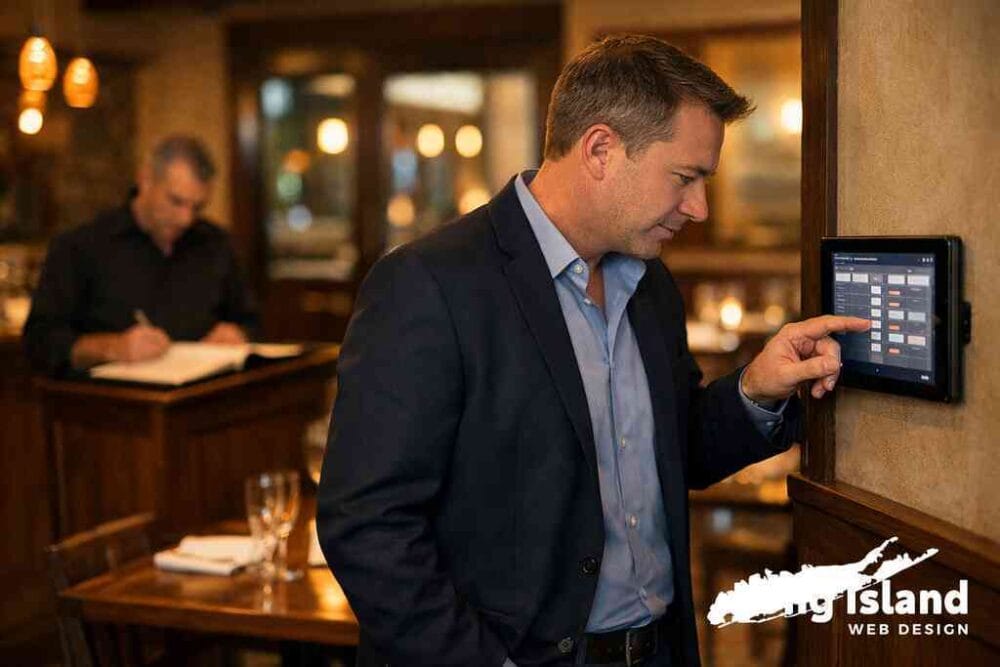
Online reservation system integration for Long Island restaurants helps reduce that friction. The process should feel like one clean flow from homepage to confirmation. If someone is already convinced, do not make them work for the table. Good reservation funnel optimization removes unnecessary pauses.
A Smithtown restaurateur once told us people kept calling instead of booking online. That often means the digital path feels harder than a phone call. We simplified the reserve flow, added clearer prompts, and made the form easier to scan. The goal was not flash. It was fewer abandoned attempts.
How page speed optimization and UX design for restaurants affect trust fast
Speed changes trust. A slow page feels outdated, even if the kitchen is excellent. That is why page speed optimization for restaurant websites on Long Island matters more than many owners realize. Guests decide fast, and search engines notice that behavior.
UX design for restaurants is the part that makes the site feel calm and obvious. It guides the eye to the right next action. It reduces clutter. It also supports website accessibility, which matters for every guest, not just some.
The clearest sites usually share the same traits:
- fast-loading photos
- visible hours and location
- one obvious reserve button
- clean menu categories
- mobile-friendly text sizes
- simple navigation
A site that feels easy earns more trust. That trust turns browsing into bookings.
The Long Island web design moves that keep the reservation calendar moving
Once a restaurant website starts working, the job changes. You are no longer just fixing leaks. You are building repeatable momentum. That takes better branding, smarter content, and ongoing maintenance. It also takes a local team that understands web design Suffolk County and web design Nassau County from the inside out.
When to choose website redesign for restaurants over a few quick edits
Sometimes a few edits are enough. If the reservation button is hidden or the menu needs cleanup, a focused update can help. But if the structure is outdated, a full rebuild may save time and money in the long run. That is especially true when the site no longer reflects your current brand or service flow.
A website redesign for restaurants to improve conversion rates makes sense when the site is hurting bookings across multiple pages. Maybe the navigation is confusing. Maybe the WordPress setup is old. Maybe the site does not support mobile-first indexing well. In those cases, patching one problem often leaves three others behind.
Here is what almost no online guide mentions. A partial fix can sometimes make things worse if the underlying structure stays broken. That is why a careful SEO audit and competitor analysis matter before you choose the route. It is better to know what is failing than to guess.
How restaurant branding, content marketing, and social media marketing support repeat bookings
A restaurant does not win loyalty with a logo alone. It wins it with a clear feel and a consistent message. Restaurant branding ties the website, photos, colors, and tone together. That consistency helps people remember you.
Content marketing for restaurants keeps your site useful beyond the menu. You can highlight seasonal specials, private dining options, catering, or chef notes. Blogging for business also supports search visibility when done with care. It gives search engines more context and gives guests more reasons to return.
Social media marketing for restaurants should reinforce the same story. A polished Instagram post that matches the website makes the brand feel real. A disconnected profile creates doubt. That is why a restaurant-specific web design services on Long Island plan should connect web, content, and social channels instead of treating them separately.
Why review management, local listing management, and Google Ads for restaurants work best together
A restaurant site rarely succeeds on design alone. Reviews influence trust. Listings influence discovery. Ads influence immediate traffic. When those three work together, the reservation pipeline gets stronger.
Review management helps shape the first impression. Local listing management keeps your name, address, and phone number consistent across platforms. That consistency matters for local search and for diners trying to reach you from the road. If your business appears differently in multiple places, trust drops.
Meanwhile, Google Ads for restaurants can capture high-intent searches like dinner near Commack or private dining in Huntington. The best campaigns work best when the landing page supports them. A strong Google Business Profile optimization for restaurants in Long Island profile and a clean website make the ad spend count more.
What a professional website design services plan should include for ADA compliance, maintenance, and future growth
A restaurant website should not stop at launch. It needs care. That includes website maintenance, security checks, backups, and content updates. It also includes ADA compliant website standards so more people can use the site comfortably.
A strong professional website design services plan should cover these basics:
- website hosting and domain registration guidance
- SSL certificates for secure browsing
- website accessibility review
- technical SEO support
- on-page SEO and keyword research
- schema markup
- Google Analytics tracking
- ongoing website maintenance
- future content updates and growth planning
If your restaurant expects new menus, events, or seasonal traffic, the site should be ready for that. A flexible WordPress development setup can make updates easier without rebuilding everything later. That kind of planning is part of professional affordable web design because it helps you avoid expensive rework.
The clearest next move when you want more bookings from web design Suffolk County and web design Nassau County
If bookings are flat, start with the site path, not the food. Check how fast the homepage loads, how easy the menu is to scan, and whether the reservation button stays visible on mobile. Then look at your local search presence, your Google profile, and your review signals. That simple review often reveals the bottleneck fast.
A smart restaurant web development in Suffolk County for better local visibility plan usually blends design, SEO, and local marketing. The same is true for Nassau County. One side of the island is not identical to the other, but the principle stays the same. Guests want clarity, speed, and trust.
If you want help, do not try to fix everything at once. Pick the page that gets the most traffic. Review the mobile flow. Then ask a local team to show you where the bookings are leaking. You do not have to figure it all out today, and you do not have to guess alone.
Frequently Asked Questions
Question: How does Long Island web design help restaurants get more bookings from mobile-friendly websites and responsive web design?
Answer: Restaurant guests often decide within seconds whether to stay on a site or leave, especially on a phone. Long Island Web Design focuses on mobile-friendly websites and responsive web design so the most important details stay visible right away, including hours, location, menu access, and the reservation button. That kind of structure supports restaurant booking optimization because it reduces friction and helps diners move from interest to action faster. For restaurants in Commack, Huntington, Smithtown, Babylon, and nearby Long Island areas, a strong mobile experience can make a big difference in local search visibility and conversions. We also think about page speed optimization, UX design for restaurants, and call-to-action placement so guests do not have to hunt for the next step. When the website feels easy to use, it feels trustworthy, and that trust helps turn visits into table reservations.
Question: What makes restaurant website design different from general small business website design?
Answer: Restaurant website design has to do more than present a brand. It needs to support online booking integration, menu page optimization, location page optimization, and reservation funnel optimization in a way that feels natural to hungry visitors. Unlike many other small business websites, restaurants depend on fast decisions, so the site must answer practical questions immediately: Are you open, where are you located, what do you serve, and how do I reserve a table? Long Island Web Design builds custom website design solutions that focus on that behavior instead of treating the site like a generic brochure. We also pay attention to local SEO for restaurants, Google My Business optimization, and local listing management so your online presence for restaurants is consistent across search results and maps. That combination helps build a stronger digital footprint and supports more bookings from nearby diners.
Question: How does the blog How Long Island Web Design Improves Restaurant Bookings connect with local SEO, schema markup for restaurants, and search engine optimization Long Island?
Answer: The main point of How Long Island Web Design Improves Restaurant Bookings is that design and search performance work together. A restaurant website can look great, but if it is hard to find or unclear to search engines, it will not bring in enough reservations. That is why Long Island SEO, local SEO for restaurants, and technical SEO matter alongside visual design. We help restaurants strengthen on-page SEO, keyword research, and schema markup for restaurants so search engines understand important details like business type, hours, and location. This can improve local search visibility for people looking for dining options in Commack, Suffolk County, Nassau County, and other Long Island service areas. In practice, that means your website is easier for nearby diners to discover, easier to trust, and easier to book from once they arrive.
Question: Can website redesign for restaurants improve conversion rate optimization if the current site already has a reservation system?
Answer: Yes. Even if a restaurant already has an online reservation system, the surrounding website can still block conversions if the layout is confusing, the navigation is cluttered, or the call-to-action placement is weak. A website redesign for restaurants can improve conversion rate optimization by making the reserve button more visible, simplifying the menu flow, and reducing unnecessary steps before booking. Long Island Web Design looks at the whole user journey, not just the reservation form itself. That includes website maintenance, page speed optimization, mobile-first indexing, and ADA compliant website considerations so the experience works for more users. If the current site feels outdated or difficult to manage in WordPress development, a redesign may be the better long-term option than small patches. The goal is always the same: help your restaurant website work harder for real bookings.
Question: What digital marketing services help restaurant branding and repeat bookings after the website is launched?
Answer: A strong website is only one part of growing restaurant bookings. Long Island Web Design also supports restaurant branding, content marketing for restaurants, blogging for business, social media marketing for restaurants, Google Ads for restaurants, and review management so the restaurant stays visible after launch. These services help keep your message consistent across your website, social channels, and search results. For example, a well-maintained Google My Business profile, strong local listing management, and ongoing website maintenance can make it easier for guests to find the restaurant again and book another visit. We also consider off-page SEO, backlink building, and competitor analysis as part of a broader strategy to improve online presence for restaurants. When design, content, and digital marketing work together, the restaurant becomes easier to remember, easier to find, and easier to choose.